Tuesday, 16 June 2015

Day 223: At home with the nomads

After re-packing (we moved everything we didn't immediately need into Kate's pack and left it at the hostel) and having a very cold shower, we went downstairs and met our guide, Otgontuul (Tuul for short), our driver, Nyama, and our super-cool Russian van. After throwing everything into the back of the van we hit the road, Nyama skilfully navigating his way through the busy streets of UB and out to a nice, shiny supermarket on the edge of the city where we stocked up on supplies for us and gifts for our hosts.

We then drove out into the countryside, the tightly packed communities of fenced-off compounds - each with a ger or two, and some with a small building as well – giving way to rolling hills of dry yellow-brown grass. We made a couple of quick stops along the way – once to wonder at a long line of brightly clothed walkers and then for a quick bit of duct-tape repairs on the van's accelerator pedal. Our next stop was at the enormous stainless steel statue of Chinggis Khan – the world's tallest statue of a man on a horse. Inside the statue's plinth were some interesting museums, the world largest boot (I think it's a size 924) and the world's largest horse whip. There was also an elevator that took us up to a viewing platform on the horse's head, where we got some great views of the surrounding countryside. 


A little further along the road, Nyama took us off-roading, driving up to the top of a hill for lunch. While he and Tuul set up a table and chairs and laid out a wonderful spread of food, we kicked around the football they'd thoughtfully brought with them. When it came time to eat, we were joined by a few stray dogs that sat quietly nearby and looked longingly at our food. 


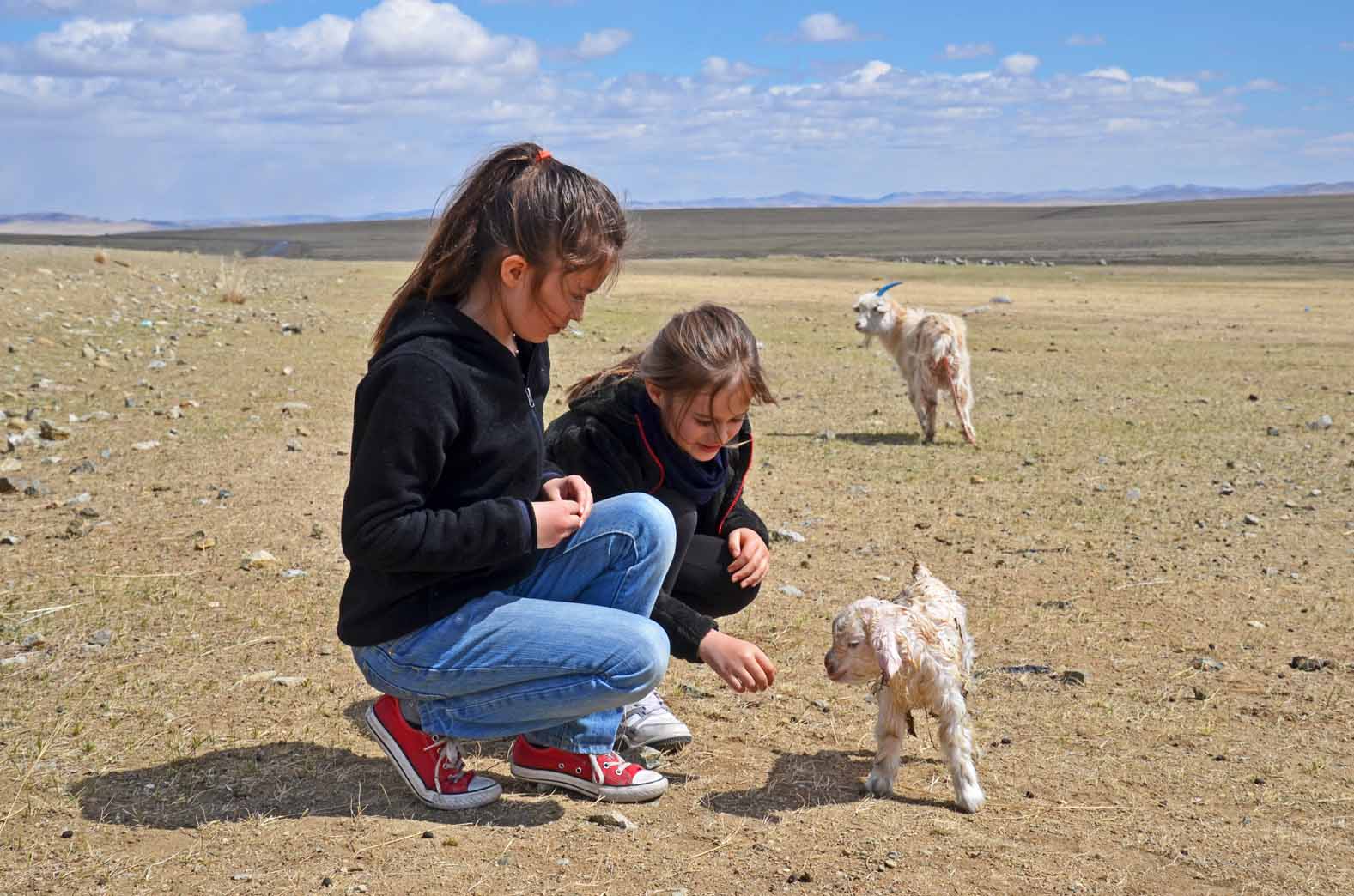
Back on the road, we drove through more of the same dry countryside, making another unscheduled stop when Nyama spotted some people gathered around a newborn kid – so new that the mother was still trailing the umbilical cord behind her. Not much further on we left the tarmac and headed into the hills, passing under the railway line that will take us to Beijing in a bit more than a week's time. We also stopped at a lake to check out the birdlife and then to see huge flock of sheep and goats being tended by a young man on a horse, and some delightfully shaggy yaks.


Not long after that we reached the camp that would be our home for the next two nights – three gers, some animal pens and a pit toilet. After being greeted by our hosts, we were shown to the ger in which we would be spending the next two nights, and then ushered into our host family's other ger (we were going to be sleeping in their main ger; the other belonged to another family, which we ended up seeing only rarely). Inside, we were all given our first bowls of hot Mongolian 'tea' – essentially vaguely tea-flavoured milk – a staple here and an integral part of Mongolian hospitality. I managed to finish mine, but Kate and the girls really weren't keen and just took the few sips necessary to avoid being rude.


Our host family consisted of a husband and wife and their six-year-old daughter (their other children were in UB attending school). The wife is a ranger in the nearby Gun Galuut Nature Reserve, which we'll be visiting tomorrow. Through Tuul, she told us the story of how she had come to be the ranger. Apparently, when she was young, she had taken great delight in killing her way through a swathe of the local wildlife. As she got older, she was so overcome by guilt at her juvenile carnage that she vowed to do something to balance things out, so she studied conservation at university and came out to look after the nature reserve and teach the locals not to do as she had done.

As this was our first introduction to a working ger (rather randomly, we once stayed in a genuine ger during a trip to France), we were fascinated to see how they worked. As they are the family's home, they are bedroom, kitchen and store room. At the centre is a cast-iron stove with a chimney that goes up through a central opening at the top of the ger. The stoves, which are fuelled with a mixture of wood and dried cow dung, both heat the gers and are used for cooking. A central plate can be removed and a wok-like pan placed in the hole. The fire makes the ger baking hot when it's burning but the dung and wood burn incredibly quickly, so not long after you go to bed, the temperature can drop pretty quickly, despite the excellent insulation provided by the felt walls. At night, light is provided by bare bulbs that are powered by big batteries that store electricity provided by big solar panels attached to the roof of the ger.

As soon as they were allowed, the girls rushed out to play with the numerous lambs and kids in a pen outside. Meanwhile, I helped to make dinner – rolling out dough for some 'pancakes' and then taking a turn at cooking them in a wok of hot oil. Unfortunately, I was given very little instruction, so did everything wrong the first time, but eventually got the hang of things and I think I was of some help in the end. Mongolian nomad cuisine is pretty basic, revolving around flour, water, salt, either dried or fresh meat (either goat or mutton) and root vegetables such as carrots and potatoes, occasionally livened up some cabbage or onion. For dinner tonight we had mutton soup, accompanied by the rather nice fried pancakes I had helped to make earlier. 


In between the food prep and dinner, I spent a bit of time wandering around photographing the countryside, which is bare but dramatic. Just behind the camp is a huge pile of rough stones, surrounded by a rectangular perimeter made up of more stones. This, we were told is an ancient burial mound – several thousand years old – one of several in the area. 


Monday, 15 June 2015

Day 222: In the Black Market

After breakfast, we headed out to the so-called Black Market. Yesterday, when we mentioned to the woman at the information centre that we were thinking of going there, she blanched a little and said 'Oh no, you don't want to go there.' The Lonely Planet was pretty discouraging as well, warning of pickpockets and bag slashers, but Anna had suggested that we check it out and we were game (and as regular readers will have noticed, we love a market), so off we went. Getting there involved catching a bus on one of UB's main roads - Peace Avenue - which took a while. The bus we eventually boarded got progressively more crowded as we travelled and the girls were forced to give up their seats to some elderly locals. The old woman who took over Zoe's seat spoke a little English and was most taken with her. She eventually beckoned her over and made her share her seat with her, leaning forward at one point, burying her nose in her hair and inhaling deeply, much to our amusement and Zoe's discomfort.

So, we were all quite pleased when we reached the market. Another friendly old lady led us to the entrance and then we began to explore. It's largely a clothing market (for Sydney-siders, it's a lot like a low-rent version of Paddy's Market), but scattered around are stalls selling just about anything your average Mongolian could need – from beds and sewing machines to horse tack, solar panels and various spare parts for gers. We forgot to bring any sunglasses for Zoe, so we shopped around and eventually found a very cool pair for her. We also bought some socks and toothpaste, a shopping bag and a Burton Snowboards cap for me (for the equivalent of only £3!). 


As we wandered, the weather went from sunny and reasonably warm to overcast and cool to freezing cold, windy and snowing. By this point we were all pretty miserable, so we gave up and went back to the bus stop and back into the city. We got off near where we thought there was a burger restaurant that came highly recommended, but try as we might, we couldn't find it. I left Kate and the girls in a playground and walked around and around looking for it. I was just about to give up when I spotted a sign not far from where the girls were, so we all went there but we still couldn't find the restaurant. It turned out it was in a bare room in an unmarked building adjacent to the sign. And yes, the burgers were good.


After a coffee at the super-cool Cafe 9 and then a bit of rest and relaxation back in the room we went out for dinner at a vegan restaurant in a Buddhist meditation centre. Kate has been craving veges since we left Western Europe, so she was in some sort of heaven. The food was certainly tasty and not at all expensive.


Day 221: UB for you and you and you and me

This morning we awoke to a knock on the door at 5.45am from one of the train ladies. Outside the window, there was quite a spectacular sunrise as we approached Ulaanbataar (or UB, as it's known locally). We had a treat in store for us today – we were being met at the station by the lovely Anna (and a driver) from Panoramic Journeys, the tour company about which I'm writing a feature and which will be looking after us during our time in Mongolia.


After dropping us at the Lotus Guest House – and presenting us all with some great felt slippers – Anna took us (through a very light snowfall) for breakfast at a little place called Soup Bar, on the way introducing us to the perils of crossing the road in UB. Cars are a relatively new innovation for many Mongolians, and the niceties of traffic rules have yet to take hold, so when you attempt to cross a road, you take your life in your hands – the green man holds little sway here, cars zipping around corners as you're trying to cross and showing little desire to give way to you.

After breakfast, Anna left us to our own devices. We stopped to check out a local playground (while a bit more snow fell), got some cash and then visited the information centre, where we got a city map and had our third lesson in how to say 'thank you' in Mongolian. It's a very odd word. Apparently, it's spelled bayarlalaa, but that doesn't come close to explaining how it's actually said – which involves sending air down the sides of your tongue while it's stuck to the roof of your mouth as you say the first l (and not saying the second one at all). If I was trying to spell it phonetically, I reckon it would look something like bya-xshla. Only Zoe ever really mastered it.

We then went back to the room for a little rest and to have a look on TripAdvisor for some restaurant recommendations, which proved to be next to useless when we headed back out again for lunch. In the end, we ate in a funny little local place, where Kate asked the server, who spoke very little English, to order for us. Our meal, when it came, was perfectly edible, if not exactly haute cuisine.

We then wandered down the road to the new dinosaur museum, stopping off first in a big square, where there was some sort of market/fair on, complete with people dressed up as a tube of mayonnaise. The Gobi desert region in southeastern Mongolia is a bit of a hotspot for dinosaur fossils – including some very impressive Tyrannosaur skeletons. For some time there has been a lucrative smuggling racket going on, with some of the best finds being secreted out of the country and sold to rich American collectors. However, the Mongolian government has been cracking down on the trade – and even repatriating some of the better skeletons. Sadly, the museum was a pretty rudimentary affair – just one big room with a few big skeletons - but one of them was a huge pretty much complete Tyrannosaur that more than justified the entrance fee.


Afterwards, we walked down to the State Department Store, stopping to buy a cute and very cheap dress for the girls, and then on to Sükhbaatar Square, the very impressive main square in UB, which contains a huge marble statue of Chinggis (Genghis) Khaan. While Kate and Zoe crossed the road to check out the opera and ballet theatre to see if there was anything on while we were in town, Sarah and I sat in the square, where we were approached by two shy and giggly female Mongolian students who wanted to interview me for an English project.


Day 220: Back on tracks, part 5

This crisp, sub-zero morning we were up and out by 6.30am, making the mercifully short walk to the train station, where our carriage awaited. Most of the train was Russian, but our carriage was Mongolian, and proved to be spotless. It was looked after by two Mongolian women who cleaned it tirelessly, almost pathologically. As we settled in, we couldn't help noticing that for the first time, we were sharing our carriage with a significant number of non-locals, including a Brit, two Uruguayans and at least four Germans. 


We eventually got to talking to them, and of course, they all had some interesting stories to tell. One German woman was on her way to Kathmandu to grant her sister her dying wish and scatter her ashes into one of Nepal's holy rivers. This wasn't long after the terrible earthquake had struck the country, but she was clearly very determined and wasn't going to let a devastating natural disaster get in her way. Evidence of that determination could also be found in the fact that because German law prohibits the possession of human remains of any sort, she had bribed someone at the crematorium to get the ashes.

After the rather monotonous pine and birch of the previous trans-Siberian legs, we now entered a region of more interesting scenery, passing some very picturesque hills and an enormous lake, all of it livened up by a series of snow flurries of varying strength. We even managed to spot some wildlife, including a fox and some pretty cranes.


In the afternoon, we reached the Russian frontier, where the train stopped at a station so we could undergo the border-crossing formalities. Like the other passengers, we got out and walked around on the platform, but it was pretty cold, so we were soon back on the train, just in time for it to fire up and pull away from the platform. We were very glad we were on board, as Kate would have been having conniptions as she watched the train motoring off, but of course, we were only changing lines so that we could get rid of the Russian carriages, which appeared to be heading back the other way, and gaining another Mongolian one, and we were soon back beside the platform. 


Because the train was stopped in the station, the onboard toilets were locked, so we had to use a pay toilet on the platform. To kill some time, I walked out of the station and up the road, where there was a very sparsely stocked shop. The plan was to spend the last of our roubles, but there was so little on offer that all I could manage to buy was a couple of ice creams for the girls.

While we waited at the station, a series of Russian officials and military types boarded the train, each one demanding to see our passports. These included a soldier with a big Alsatian and a guy who went through our bags and checked all of the various hatches, nooks and crannies in the carriage for I'm not sure what. Eventually, a border guard straight from central casting – a slim, stern, severe, yet attractive young woman, crisp of uniform, rigid of bearing – arrived at the doorway of our cabin and asked for our passports. This, finally, was the real deal – she removed the oh-so-very-important slip of paper that was sitting loose in each of our passports, scanned the identity pages with a nifty hand-held electronic device and then, one by one, stamped them and handed them back. We were free to leave!

However, the same wasn't true for everyone on board. As we all stood/sat/lay around waiting for the train to leave, a ripple of excitement passed through the carriage – one of the Uruguayans had been marched off the train by the Russian border guards. He had overstayed his visa by a couple of days, a possibility that had had Kate sweating since before we even reached Russia. The news of course ignited a round of fevered speculation as to what was now happening to him and what would happen to his luggage, which was still on board, but in the end he re-appeared just before the train left. Almost disappointingly, the guards had been incredibly polite and had fined him a token amount, with the formalities all carried out in great haste in order to ensure that he made it back on board in time.

Not long after, we crossed the pleasingly fortified border into Mongolia and soon the train was pulling to a stop adjacent to an army post. A number of young armed soldiers stationed themselves beside the train as we waited for the officials to arrive, but not long after, we were on the move again. As we pulled away, the soldiers solemnly saluted us, and when the determined German woman blew one of them a kiss, he broke into a huge smile.

A bit further on, we pulled into another station (and the toilets were locked again) and it was here that the Mongolian border officials got on. This time we had to fill in a series of forms – visas, customs and medical – all of which were scrutinised and then approved, much to our relief. This was the cue for a local money changer to hop on board and go from compartment to compartment, giving us the opportunity to divest ourselves of the last of our roubles (apart, from the little collection Kate that forgot she had in her wallet).


Excitement over, we had a dinner of pot noodles and Bordeaux, lay down in our bunks and clickety clacked our way into Mongolia. Later, I awoke in the middle of night and needed to go to the toilet but once again we were stopped in a station so once again, the toilets were locked. When we finally got back on the move – at around 1am – I still had to wait as one of the carriage attendants felt that this was the perfect time to clean the toilets.

The blog is back!

We've just arrived in Hanoi, which means that we're finally back on the other side of the Great Firewall of China and I can start blogging again. Expect a flurry of posts over the next days and weeks as I do my best to bring you all back up to date – through Mongolia and China and into Vietnam.

We're all fine (if a little tired after dragging ourselves off the train at midnight for the border crossing into Vietnam) and still having a great time. The weather has warmed up significantly and the humidity is a thing to behold but we're all coping pretty well (indeed, Sarah is thriving). We're very sad to have left China but excited to see what Vietnam and the rest of Southeast Asia has to offer.